
Over the past several years, KAM Isaiah Israel has conducted a major restoration of our historic, 100 year old sanctuary. On Sunday, December 14, we held a festive ceremony for its rededication. Here you can review highlights from the event!
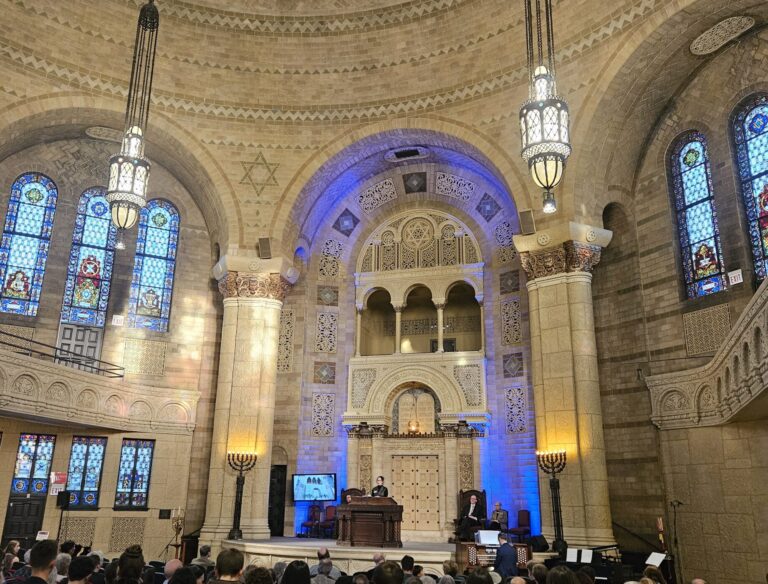
Good afternoon and welcome, my friends. My name is Daniel Kirzane, and I am honored to serve as the rabbi of KAM Isaiah Israel. I couldn’t be happier to welcome you to this sanctuary, whether you’re new to our space or consider it
your second home—and everything in between.
Before we formally begin, we need to pause for a moment of somber reflection. As we slept, Jewish communities across Australia began their celebration of Hanukkah. One such celebration, hosted by a Chabad community in Sydney, was shattered by a horrific attack that left eleven dead. Here in America, another mass shooting—at Brown University in Rhode Island—shattered the lives of students and faculty preparing for their final exams and has resulted in two innocent people killed. We pause for a moment of silence as we sit in sadness and grief.
Our program will continue as planned, for we cannot allow violence to disrupt our gatherings of celebration and peace. The Lubavitcher Rebbe, Menachem Mendel Schneerson, taught, “Where light is, darkness is not. A thimbleful of light will
therefore banish a roomful of darkness.” (Source) As we begin Hanukkah, the Festival of Lights, may we commit ourselves to drowning the darkness with our own thimbles of light.
It is my pleasure to welcome our congregation’s president, Julie Volchenboum, to begin our ceremony.
Shalom and welcome to KAM Isaiah Israel! My name is Julie Volchenboum, and I am thrilled to commemorate this occasion with you on this bright and frosty December day. In Chicago, we take pride in braving the snow and the cold, but I know the weather prevented some folks from getting here. Unfortunately, Cantor Miriam’s flight was canceled this morning, and we miss you! Hello to our friends in the livestream audience. It’s my privilege to introduce you to this glorious space – a place where many people over the last century have gathered to worship, make music, learn, entertain, and celebrate. I’m excited to present today’s program and especially to thank the leaders who inspired and sustained this grand project. Repairing, restoring, and now rededicating this sanctuary required years of devotion, and I’m the lucky president, stepping into this role as we are nearing completion. I’m grateful for the opportunity to share this accomplishment with you – our family, members, friends, neighbors, and the greater Jewish Community. History and legacy are important, but not as much as our commitment to our vision, mission, and values. We look forward to collaborating with you and striving for tikkun olam – repair of the world. Happy Chanukah!
The word Hanukkah means “dedication.” The holiday of Hanukkah recalls the rededication of the Temple in Jerusalem, which had been defiled by foreign rule and idolatrous worship. Judah Maccabee and his followers defeated their enemies and restored the sanctuary to the worship of God. They reignited the seven-branched menorah, the ancient symbol of our faith, and sparked in a season of darkness a festival of light that has brought hope to our people for countless generations.
Centuries later, when the sages of our tradition reflected on the meaning of this holiday, they wrote down for the first time the famous story of the miracle of oil.
The story goes that the Maccabees could find only a small jar of the oil needed to light the menorah with fuel enough to burn for only a single day.
Nevertheless, נַעֲשָׂה בּוֹ נֵס וְהִדְלִיקוּ מִמֶּנּוּ שְׁמוֹנָה יָמִים “A miracle occurred and they lit from it for eight days” (BT Shabbat 21b). These eight days of light inspired the new symbol of the
nine-branched menorah, which Jews around the world light each night of
Hanukkah.
We might ask: On which day did the miracle occur? Was it on the second day when the oil started to burn longer than expected? Or does the miracle last all the way through the 8th day, pulsing constantly in the fire for more than a week? Or maybe—and this is my favorite answer—the miracle occurred on the first day because the Maccabees lit the fire even though they expected it to burn out. This is where we stand today, lighting the first candle as a symbol of resilience and
hope. And as we light this first, most brave candle, we pray this historic sanctuary, which we also rededicate tonight, will shine as a beacon of hope for generations to come.
We are thrilled to invite two esteemed members of our congregation to light the menorah today. For forty years, Fred Stein served as the chair of our House Committee, and it was under his diligent and loving care that the restoration of this sanctuary was launched. Patrick Rosen serves as our current House Committee chair, and he has devoted countless hours to the last stages of our restoration work and the many projects that come next. Fred and Patrick, thank you for all you have done and continue to do for our community and for the brilliant work you’ve done restoring this beautiful space.
Jewish spaces are adorned with Jewish words. We hang in the doorway a mezuzah, which contains the words of the Shema, the watchword of our faith. Carved in stone here above our holy ark, the Shema says, “Hear, O Israel, the Lord our God, the Lord is One.”
It is with great honor that we invite forward the former president of our congregation, and the chair of the committee who planned this rededication, Lenore Mass. When Lenore completed her term as temple president last summer, the congregation presented her with this mezuzah as a symbol of the blessings she has bestowed upon our community. In a moment, Lenore will hang the mezuzah on the side entryway to our sanctuary, the door we most frequently use to come in and out.
That door is named the Stephen S. Wise portal after one of the rabbinic luminaries of American Judaism. Stephen Wise founded the Jewish Institute of Religion, which would later merge with the Hebrew Union College to create America’s largest Jewish seminary. Rabbi Gerson Levi of Temple Isaiah Israel was a close colleague of Stephen Wise, and our congregation’s beloved Rabbi Hayim Perelmuter was a dear friend of Rabbi Wise, who even officiated at his wedding.
We are honored to finally affix a mezuzah to the Stephen S. Wise portal; and we thank you, Lenore, for all you have done to support this congregation in your decades of leadership.
Once the mezuzah is in place, the first person to walk through the door will be our incredible executive director, Osnat Strulov-Shlain. Osnat is responsible not only for the running of this entire event but also for the operation of our synagogue every single day. Her commitment to our congregation extends far beyond operations, though, and her love of community, her passion for joy, and her devotion to openness and accessibility help make our congregation the warm and welcoming place that it is.
Osnat will carry with her a Torah scroll, our most sacred object, which we will place in the holy ark. The Torah is our Tree of Life, our source of wisdom and inspiration, and placing the Torah in our midst is a central symbol of the dedication of this sacred space.
Bless all who enter this sanctuary in search and in need, all who bring to this place the offering of their hearts. May our worship here lead us to fulfill our words and our hopes with acts of kindness, peace, and love. Amen. (From Gates of Prayer.)
בָּרוּךְ אַתָּה, יְיָ אֱלֹהֵֽינוּ, מֶלֶךְ הָעוֹלָם, אֲשֶׁר קְדְּשָֽׁנוּ בְּמִצְוֹתָיו וְצִוָּֽנוּ לִקְבּֽוֹעַ מְזוּזָה.
Blessed are You, Eternal our God, Ruling Spirit of the universe, who hallows us with mitzvot, commanding us to affix the mezuzah.
Please rise as we welcome the Torah to the ark.
Dedication to Community:
On the Rededication of KAM Isaiah Israel’s Historic Sanctuary
We Jews are a people on the move.
Our father Abraham was called the first Hebrew, meaning “one who crosses over,” and the mythic formation of our nation occurred in the wilderness as our spiritual ancestors received God’s word at Mount Sinai’s rocky foot. Beyond the bounds of legend, Jews have wandered from Judea to Babylonia and back, to Alexandria and Africa and Assyria and Rome, to European town after European town and Muslim empire to Muslim empire. We have crossed every sea and settled in every continent; and while half our population today reside in the State of Israel, Jews continue to call home every corner of the globe.
How have we managed to survive and thrive in so many places? In a word: dedication. Wherever we go, we set aside a special space and call it holy; and this space serves as a reminder of the values we hold, values which—truth be told—hold us as well. By dedicating sacred space, we reiterate our noble causes and robe in stone the pursuits of peace and truth that have sustained our people in every age.
Consider our first communal building project, the Tabernacle the Torah describes built on our wilderness trek from Egypt to the Promised Land. More than a third of the Bible’s Book of Exodus describes the design and construction of this sanctuary, called in Hebrew a mishkan, a dwelling-place for God. This is the space for common Israelites to come face-to-face (so to speak) with God, presenting on the altar offerings that symbolize their connection with the Creator. The first recorded dedication is of this altar:
זאֹת חֲנֻכַּת הַּמִּזְבֵּחַּ אַּחֲרֵּי הִּמָּשַּח אֹתוֹ , “This was the dedication of the altar after its anointing” (Numbers 7:88). (Note 1) God knows, the Torah tells us, that the people need a physical meeting place to ground their devotion; and the Tabernacle, with the altar within, serves as the perfect image of interaction between human and divine.
Those who wrote this story, who read it and passed it down and saw in it a lesson for all time recognized a very important truth: We don’t look for God everywhere, but we can find God anywhere. By setting aside a special place or thing, and then by entering or touching or lifting or using it with purity of intention and wholeness of heart, our minds transcend the material realm, drawing our focus to that which matters most. The object itself bears no mystical power but rather unlocks in us the power to reach beyond ourselves.
And so it was with the Temple in Jerusalem, the centerpiece of Jewish worship for nearly 1000 years. The Bible tells of its ceremony of dedication, replete with details of the building’s grandeur and glory (1 Kings 8). More important than the Temple’s physical resplendence, though, are the prayers which Solomon pronounces during its dedication. In five cascading paragraphs, Solomon prays for justice (vv. 30-32), forgiveness (vv. 33-40), openness (vv. 41-43), defense (vv. 44-45), and restoration (vv. 46-51). וּפָּנִּיתָּ אֶל־תְפִּלַּת עַּבְדְךָ , “And turn, O Eternal my God, to the prayer and supplication of Your servant … to open your eyes day and night toward this House” (1 Kings 8:28-29). This is a prayer for Solomon’s age and a prayer for our own, a prayer beseeching blessing in a time of need and consecrating in a holy space our commitment to walking in divine paths.
These ancient stories of dedication—of the wilderness Mishkan and the Jerusalem Temple—are the blueprints for dedications and rededications through Jewish history. The Maccabees—whose triumphant restoration of the Temple to Jewish hands we celebrate tonight—rededicated God’s house to the service of the Most High. And later, over centuries of dispersal throughout the world, Jews would build and dedicate synagogues, each a mikdash m’at, a “small sanctuary” modeled on the Temple itself. In every city, village, and town where Jews lived, we brought our values with us, our sacred and eternal reminders of the power and the presence that accompanies us in our journeys as well as our purpose and drive to maintain the mandates of our religion and to make the world better for our having lived upon it.
KAM Isaiah Israel is no different. We, too, concretize our values in the space we call sacred, and we express our religious commitments by coming together under the umbrella of shared concerns. The briefest review of our history reveals that our community has remained consistently introspective, allowing for people of similar sentiments to organize at will, sometimes with independence and sometimes with unity or reform.
The parent of our congregation—and, indeed, the parent or grandparent of most of Chicago’s Reform synagogues—was Kehillat Anshe Maarav, KAM, the “Congregation of the Men of the West.” Founded in 1847 as Illinois’ first Jewish congregation, KAM from its earliest days walked the tightrope of tradition and change. They welcomed religious reforms and modern practices, sparking a breakaway congregation called B’nai Sholom to serve the needs of more traditional Jews. But KAM refrained from the most radical reforms of the day, resulting in a second breakaway, Chicago Sinai, for those who sought change at a faster pace. From these communities later arose Temple Israel (Note 2) and Isaiah Temple (Note 3), which merged in 1924 when Isaiah built this magnificent sanctuary—and the reunification of all these communities was complete in 1971 when KAM and Isaiah Israel merged into the congregation we know today. The values enshrined in this sanctuary, painted on glass and etched in stone, represent the enduring commitments of our congregation, which give us direction and drive in tranquil or turbulent times.
All Jewish synagogues have three primary functions. A synagogue is a beit midrash, a house of study; a beit t’filah, a house of prayer; and a beit k’nesset, a house of assembly. KAM Isaiah Israel fulfills these purposes with the values that adorn our stained glass windows, the values of truth and holiness, piety and love, justice and peace.
As a house of study, this synagogue stands for curiosity and deliberation. Ours is a community concerned with history, its lessons and its legacies, and we make it our business to know from whom we came. Here we blend all areas of knowledge in our pursuit of truth, finding meaning in music and literature, science and philosophy, politics and, of course, religion. Indeed, the principles of Reform Judaism insist on the rigorous pursuit of truth, even (and especially) if it requires adjusting our prior beliefs when we learn something new – so we experience holiness when the treasures of the past glitter with the light of the present and illuminate our path to the future. In an age where truth is mocked and set aside, where partisan demagogues and billionaire robber-barons flatten society into an ugly and pugnacious us and them; in an age where the validity of facts seems to stem from the newspaper or TV channel they’re published in; and in an age where higher education is under attack by those who profit from cultural strife, being dedicated as a house of study is a form of nonviolent resistance to the forces that would deaden us. We study to grow deeper in our understanding of ourselves, one another, and the world and so that we might know how to bring this world a little closer to the sacred ideals of our faith.
As a house of prayer, this synagogue stands for innovation and inclusion in the context of a robust engagement with tradition. The folkways of our people—our liturgies, customs, and rites—come alive with each new generation, and our piety is expressed in creative conversation with Jewish practices from around the world. You will find here the celebration of every Jewish holiday and some non-Jewish ones as well. You will find here a passionate devotion to the texts of our people as well as the braiding together of modern and ancient poetry and song. And you will find here the rich commitment to the power of prayer, for where better than a house of worship to find the time and space to encounter God? We believe that Jewish life can enrich anyone who wishes to connect with it, and we strive to make the wisdom and inspiration of Judaism available to all. Jews of every race and nation and cultural background—as well as people who aren’t Jewish and who will never be—are welcome in this community. We aspire to embrace with love people of all genders, colors, and sexualities, ages and abilities – and yes, even political parties. Diversity strengthens our commitment to Judaism, and we embrace Isaiah’s ideal: “[Our] house shall be a house of prayer for all peoples” (56:7).
And finally, as a house of assembly, this synagogue stands for standing together. This is a place to build and strengthen community, to make new friendships and deepen old ones, to remind ourselves of the power of relationships to bring stability in a world that seems, at times, unmoored from any sense of responsibility. Americans have gone from bowling alone to watching movies alone to even shopping for groceries from the comfort of our couch. We see much more of our addictive screens than we do of one another’s faces, and ours is a space where we look up from our phones into another’s eyes and see there reflections of ourselves. These human connections are powerful, and we believe that this power can be harnessed not only to better the self but also to repair the world. We believe that justice can be achieved when allies become advocates on issues of shared concern, and we contribute to coalitions that magnify the power of marginalized groups who would struggle to succeed alone. Peace is not a pipe dream, it’s the guiding light of the world as it should be; and we know, as our prayerbook says, that “there is no way to get from here to there except by joining hands, marching together.” (Note 4)
My friends, we gather today to dedicate this space to the sacred values of this beloved congregation. In line with countless generations who have gone before us, and with humble acknowledgement that we are role models for those who will come after, we reaffirm the ideals for which we strive, and we reify them here, in this house of study, prayer, and assembly.
KAM Isaiah Israel has stood for 100 years and more for truth, holiness, piety, love, justice, and peace. And today, on the occasion of this once-in-lifetime rededication, let us add a seventh value: community. Our synagogue is not just a building; it is also the congregation that suffuses it with life. And not only this: KAM Isaiah Israel could not exist without the partnership of our neighbors and friends in the greater South Side. Our membership and our community extend beyond Hyde Park, of course, but we remain firmly and proudly rooted in the South Side. We see ourselves as a landmark and a resource in our neighborhood, and at the same time, we benefit greatly from the rich treasures that surround us. Community makes us who we are: Jewish community, South Side community, Chicago community, and human community, all dedicated, albeit in unique and diverse ways, to flourishing, improvement, and growth.
And so let us not only dedicate this sanctuary but let us dedicate ourselves to the value of community. Let us draw strength from one another in our shared pursuit of love, justice, peace, and truth. Let us take inspiration from Jewish expressions of piety and holiness even as the perspectives of all faiths deepen our appreciation of the divine.
And on this first night of Hanukkah, let us bring light into our hearts and, through our deeds, let us bring light into the world. May we feel, all of us, the warm glow of this power of community.
NOTES
It’s a privilege to welcome to the bima my predecessor as the rabbi of KAM Isaiah Israel, Rabbi Fred Reeves.
Rabbi Reeves launched the restoration of the sanctuary and deserves credit for the terrific success of the campaign that funded this whole project. I’ve been blessed to call Fred a colleague and a friend for the eight years I’ve lived in Chicago, and it is truly an honor to invite him back to this historic bima.
You will see in your programs congratulations from so many neighbors and friends. We are honored to receive words of support from Governor J. B. Pritzker, Mayor Brandon Johnson, Jewish Federation president Lonnie Nasatir, and the president of the Hebrew Union College-Jewish Institute of Religion, Andrew Rehfeld. On behalf of our congregation, I express my gratitude to all of these people for your words of support.
We are especially moved that there are several officials here from the Office of the Mayor. A very special welcome to Carla Kupe, Jason Sanford, Sara Mathers, Dominique Warren, and the Chicago Commissioner on Human Relations, Nancy Andrade. Your partnership means so much to us, and we’re so glad that you’re here this afternoon.
There’s one more message we wish to share at this time, from another friend and very close neighbor.
I’m delighted to welcome to the bima the co-chairs of the Mishpacha Campaign, the effort to raise the funds necessary for the restoration and renovation of this historic space. We are enormously grateful to campaign co-chairs Dan Mass, Lainey Canevaro Weinstein, and Amy Wishnick for your tireless work to help make this space as beautiful as it is.
We have traveled a long and much needed road to be able to admire the beauty of this restored historic sanctuary and we now are able to celebrate together.
We can look around us and see the magnificent work done to restore our Sanctuary, from our iconic stained glass windows, the completely revitalized interior that allows the master design and craftsmanship envisioned by architect Alfred Alschuler more than 100 years ago to shine once again, and for us all to enjoy our comfortable new seating!
There was also much more work done that cannot be easily seen, but provides a solid foundation for the next 100 years. Following the Talmud, we restored our parapet walls that were about to fall down on us. We also addressed the need for new roofing, stairs, and plumbing. In addition, we received a very exciting gift through an anonymous donor that went above and beyond what we raised for the campaign, a Geothermal HVAC System that will provide sustainable heat, as well as air-conditioning for the first time in the building’s 100-year history (please come back and visit us for High Holy Days to truly enjoy that addition). None of this would have been possible without the generous support of our donors and volunteers, and the expertise of our partners in this work.
While we have accomplished much, we are not finished, and have begun our second phase of the campaign – A Building for Our Community – to continue the work of ensuring safe, open, and welcoming spaces.
First up are new restrooms, new and more efficient electrical service, an accessible ramp to our Bimah, and expanded seating for our balcony. This work, while partially funded by outside granting bodies, also would not have happened without our showing such a strong commitment to raising funds from within the congregation.
We would also like to give special thanks to our House Committee for their stewardship, including past chair Fred Stein for his tireless work towards these efforts, and our current chair, Patrick Rosen, for continuing this important work. Essential to all of the work of fundraising, both internally and externally, were our professional partners, Avrum Lapin of the Lapin Group, and Gianfranco Grande of Partners for Sacred Places.
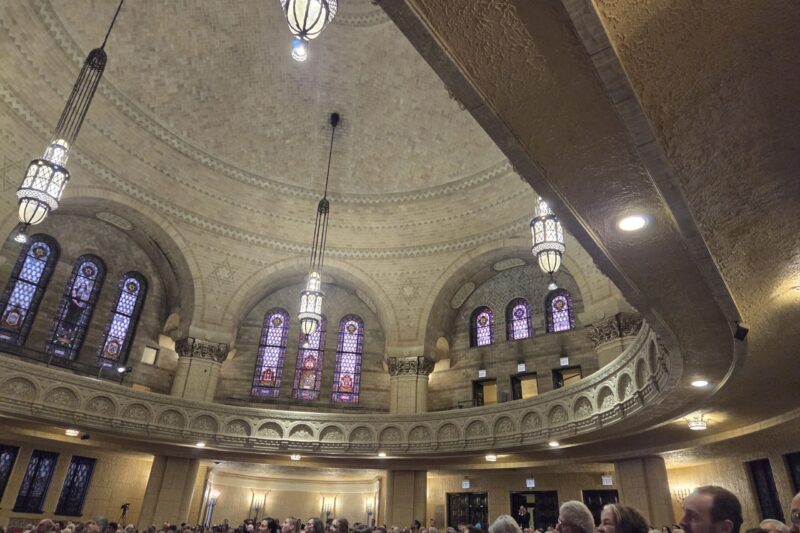


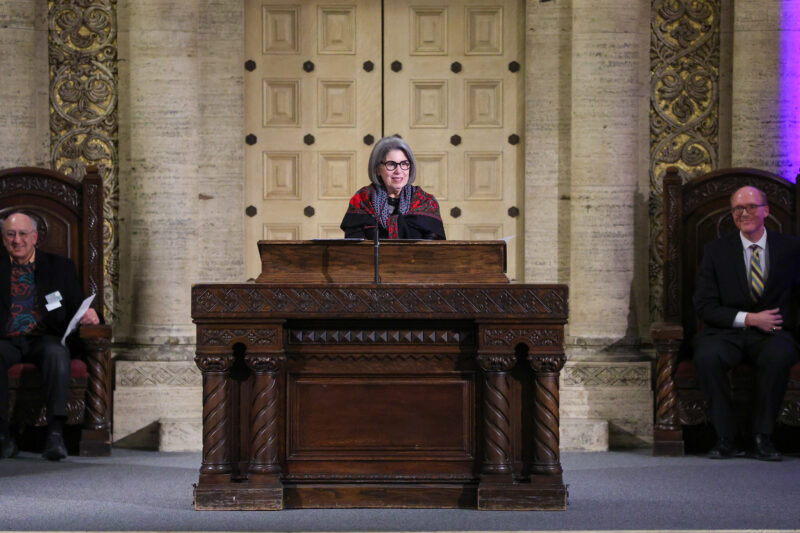

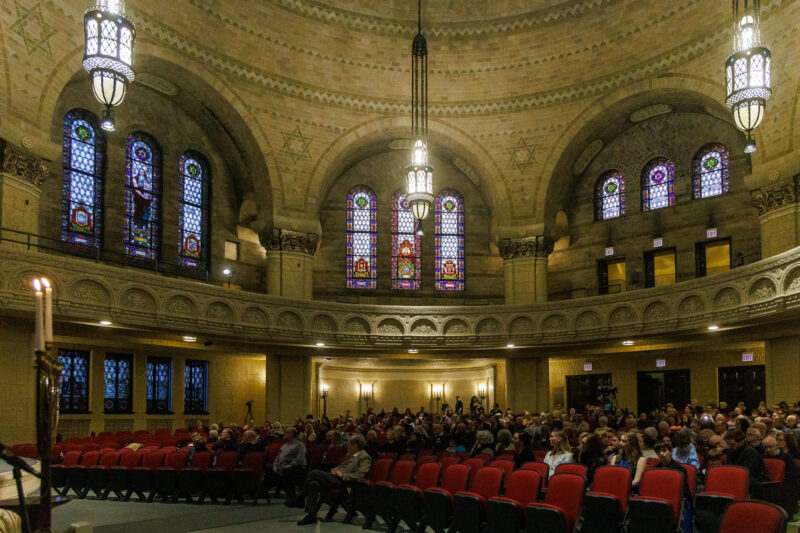

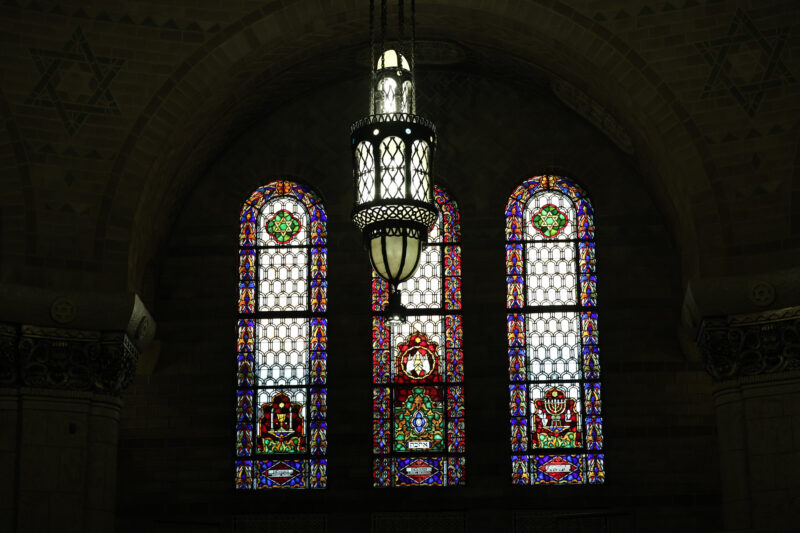
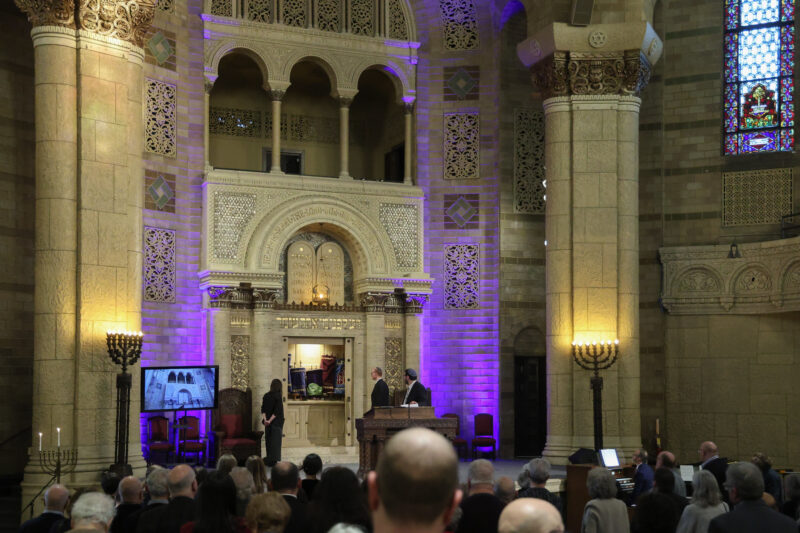
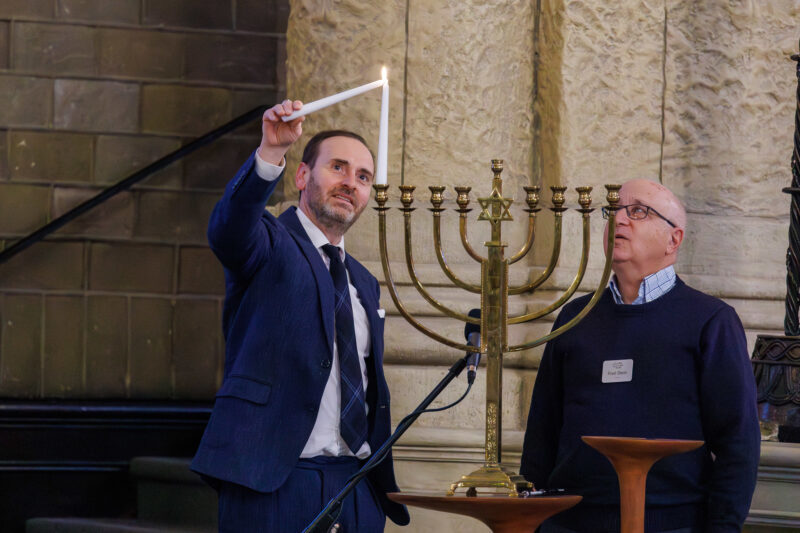
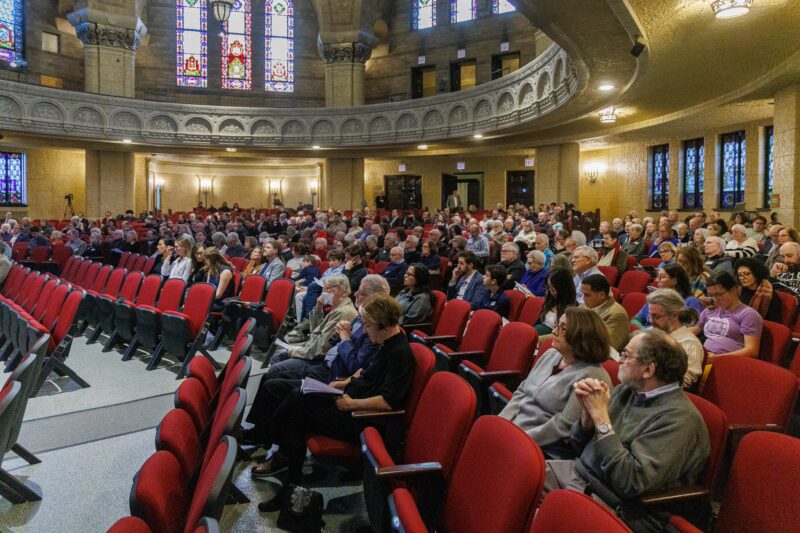
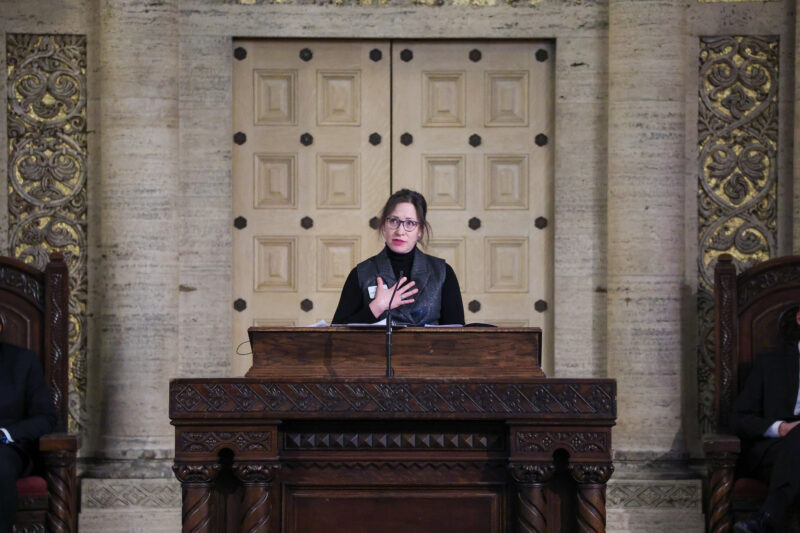
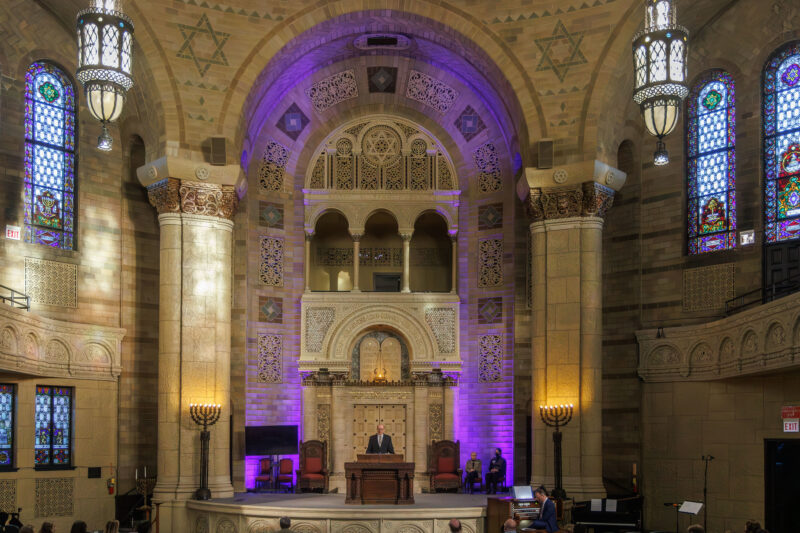
Dec. 16, 2025 – Hyde Park Herald: On the first night of Hanukkah, several hundred congregants packed into KAM Isaiah Israel to rededicate the century-old Hyde Park synagogue’s sanctuary, a celebration tempered by news of antisemitic violence abroad.
The rededication marked the completion of a three-year, more than $5 million restoration project and came just hours after reports of a mass shooting targeting Jews celebrating Hanukkah at Bondi Beach in Sydney, Australia. That attack left at least 15 dead and 27 seriously injured, according to authorities. Rabbi Daniel Kirzane opened the rededication with a moment of silence before declaring that the program would continue as planned.
“We cannot allow violence to disrupt our gatherings of celebration and peace,” he said. Read more.
Dec. 18, 2025 – Preservation Chicago on X: BRAVO! Preservation Chicago applauds KAM Isaiah Israel for their dedication to restorting their beautiful historic synagogue. At every step of the way, we’re happy to do our part to help the multi-year effort achieve successful outcomes. “KAM Isaiah Israel rededicates historic sanctuary on first night of Hanukkah Read more.
